

Nobody likes to think about a time when they might not be able to manage their own affairs. Yet planning for that possibility – before it ever becomes a crisis – is one of the most protective things a person can do for themselves and their family.
A Lasting Power of Attorney (LPA) gives you the legal authority to choose who will make decisions on your behalf should you lose mental capacity. Without one, your loved ones may have no legal right to manage your finances or make decisions about your care.
Under the Mental Capacity Act 2005, mental incapacity can affect anyone at any age – through a sudden accident, serious illness, or gradual conditions such as dementia. Acting whilst you have full capacity means staying in control, on your own terms.
This guide explains what an LPA is, the two types available, who should consider one, how to set it up, and what happens if you choose not to. Our Power of Attorney service is designed to make the process as straightforward as possible, with a free initial consultation available for new clients.
Key Takeaways
- Two types available: There are two LPAs in the UK – one for Property and Financial Affairs, and one for Health and Welfare. Both are recommended for full protection.
- Must be made before incapacity: An LPA can only be created whilst the donor still has mental capacity – it cannot be set up retrospectively.
- Registered with the OPG: All LPAs must be registered with the Office of the Public Guardian before use. Registration currently takes 8-10 weeks if there are no mistakes in the application.
- Your attorney is your choice: You can appoint any trusted adult – a family member, friend, or professional solicitor – as your attorney.
- Deputy Order is the costly alternative: Without an LPA, a family member must apply to the Court of Protection – a process that is significantly more expensive and time-consuming.
- Revocable while capacity remains: A donor can revoke an LPA at any time, provided they still have the mental capacity to do so.
- No guarantee in waiting: An LPA cannot be made after capacity is lost – the time to act is always before it becomes necessary.
What Is the Lasting Power of Attorney?
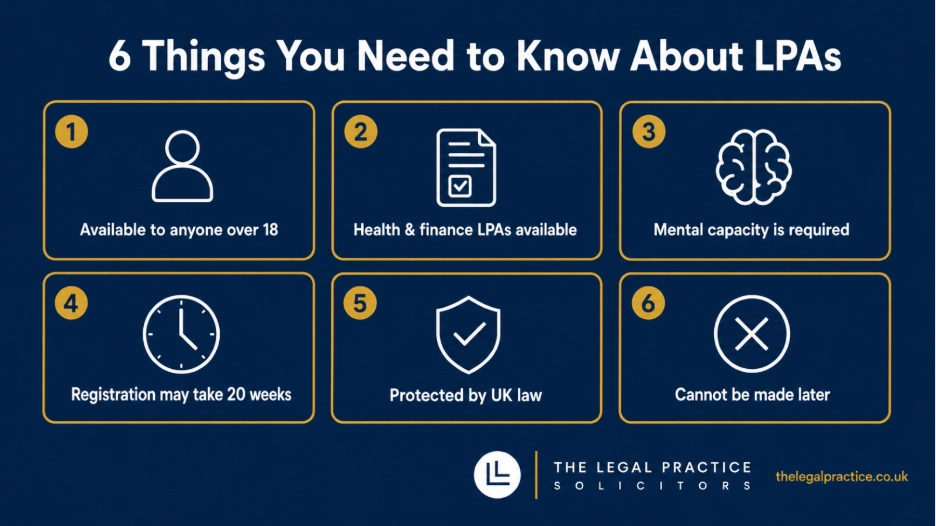
A Lasting Power of Attorney is a legal document allowing a person – the donor – to appoint one or more trusted individuals, known as attorneys, to make decisions on their behalf should they lose mental capacity. It is governed by the Mental Capacity Act 2005 and administered through the Office of the Public Guardian (OPG) in England and Wales.
An LPA is not only for elderly people or those with existing health concerns. Accidents, sudden illness, or unexpected deterioration in mental health can occur at any point in life. Anyone over 18 can – and arguably should – consider putting one in place.
It is also worth clarifying what an LPA is not. It is entirely separate from a will. A will govern what happens to your estate after you die; an LPA governs who makes decisions for you during your lifetime if you lose capacity.
For anyone thinking about their future or the future of an elderly parent, our Power of Attorney service is a straightforward first step, with a free initial consultation available for new clients.
The Two Types of LPA Explained
There are two distinct types of Lasting Power of Attorney in England and Wales. Each covers a different area of life, and many clients choose to set up both to ensure the widest possible protection.
1. Property and Financial Affairs LPA
This LPA allows your attorney to manage your financial matters – bank accounts, bills, investments, property, and any other assets. Depending on how you set it up, this type can be used even whilst you still have mental capacity, if you wish to grant that flexibility.
Your attorney may be authorised to pay bills and manage bank accounts, collect income and pension payments, buy or sell property, manage investments, and handle tax affairs. The scope can be shaped by including specific restrictions within the LPA document itself.
2. Health and Welfare LPA
A Health and Welfare LPA covers decisions about your personal care and medical treatment. Unlike the financial LPA, this type can only be activated once you have lost mental capacity – it cannot be used whilst you retain it.
Your attorney may make decisions about your daily care routine, whether you should move into a care home, medical treatment (including life-sustaining treatment if you include that provision), and communication with healthcare professionals on your behalf.
This is often the type that people overlook – and yet it can be the most consequential. Without it, even close family members may have no legal standing to be involved in decisions about your care.
Got questions about setting up an LPA? We offer a free initial consultation.
Who Can Make an LPA – and Who Cannot?
To make an LPA, the donor must be at least 18 years of age and must have mental capacity at the time of signing. Capacity is assessed under the Mental Capacity Act 2005, which establishes that all adults are presumed to have capacity unless there is specific evidence to the contrary.
The most important point – and one that is widely misunderstood – is that an LPA cannot be made after mental capacity has been lost. If that has already happened, the only route is an application to the Court of Protection for a Deputy Order, which is far more involved and expensive.
A diagnosis of dementia or another cognitive condition does not automatically mean an LPA can no longer be made. Capacity is assessed on a decision-by-decision basis. If you or a family member has received such a diagnosis, seek professional advice promptly.
The attorney must also be over 18, must not be subject to a Debt Relief Order or bankruptcy (for a financial LPA), and must have mental capacity to act. There is no requirement for any legal or financial background – though a professional attorney can be appointed where appropriate.
Who Should You Choose as Your Attorney?
Choosing your attorney is one of the most personal decisions in the LPA process. The person you appoint will hold significant legal authority over your affairs – trust, reliability, good judgement, and willingness to act in your best interests are all essential.
You can appoint more than one attorney, and you will need to specify how they act. Jointly means all must agree on every decision. Jointly and severally means any one of them can act independently. A combined approach is also possible – for example, joint agreement for property sales and independent authority for day-to-day finances.
You may also name a replacement attorney – someone who steps in automatically if your original attorney is unable or unwilling to continue. This prevents the need to go to the Court of Protection if circumstances change.
As an SRA-authorised and regulated firm, The Legal Practice holds professional indemnity insurance in line with SRA requirements. We have supported clients where no close family member is available to act and a professional attorney is the most appropriate option. Learn more on our Power of Attorney service page.
LPA vs Deputy Order – Understanding the Difference
If mental capacity is lost without an LPA in place, the only legal path is an application to the Court of Protection for a Deputy Order. Understanding the difference makes a compelling case for acting early.
| Feature | Lasting Power Of Attorney | Deputy Order (Court Of Protection) |
| When Set Up | While the donor has mental capacity | After the person has lost capacity |
| Who Decides | The donor chooses their attorney | The Court appoints a deputy |
| Cost | From £500+VAT per LPA | Several thousand pounds plus ongoing fees |
| Timescale | Weeks to months (OPG: 8-10 weeks if no errors in application) | Many months, sometimes over a year |
| Flexibility | Donor sets instructions and restrictions | Court sets the scope – less flexibility |
| Oversight | Office of the Public Guardian | Court of Protection – annual reporting |
Source: Office of the Public Guardian, GOV.UK. Registration fees correct as of 2026 – always verify the current fee at gov.uk/power-of-attorney as figures are subject to change.
Bottom Line: An LPA gives you full control over who acts for you and how. A Deputy Order removes that control and places it with the Court – at far greater cost, with significant delay, and without the personal choice of someone you have appointed yourself.
Our Power of Attorney service guides you from first consultation through to OPG registration.
How to Set Up a Lasting Power of Attorney in the UK
Setting up an LPA follows a structured process administered by the Office of the Public Guardian. LPA forms are available through GOV.UK and professional guidance helps ensure the document accurately reflects your wishes.
Step 1 – Choose Your Attorney or Attorneys
Decide who you wish to appoint before completing any paperwork. Consider not just who is close to you now, but who will be available, capable, and willing to take on this responsibility when needed. Think carefully about whether to appoint more than one attorney and how they should act.
Step 2 – Complete the LPA Forms
Forms are available through GOV.UK and the Office of the Public Guardian. They require details about the donor, chosen attorney(s), any restrictions or preferences, and a certificate provider – an independent person who confirms the donor understands the document and is signing freely.
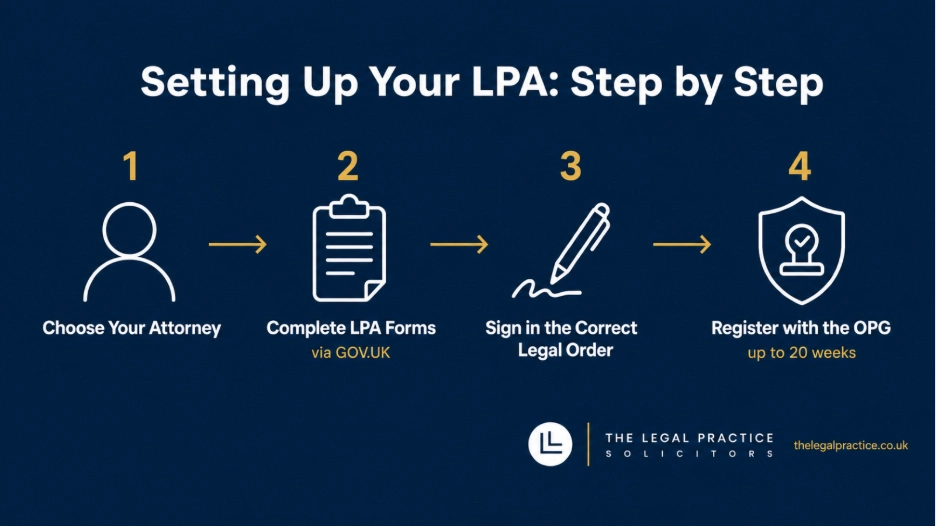
Step 3 – Sign in the Correct Order
The signing process is strictly prescribed under The Lasting Powers of Attorney, Enduring Powers of Attorney and Public Guardian Regulations 2007. The donor signs first, then the certificate provider, then the attorneys and any replacement attorneys. Signing out of order is one of the most common reasons LPAs are rejected by the OPG.
Step 4 – Register with the Office of the Public Guardian
Once correctly signed, the LPA must be registered with the Office of the Public Guardian before it can be used. The current registration fee is £92 per LPA (updated November 2025) – always check GOV.UK for the most up-to-date figure. Registration currently takes 8-10 weeks if there are no errors in the application, so submit promptly after signing.
How Much Does a Lasting Power of Attorney Cost?
The total cost of setting up an LPA includes the government registration fee and any professional legal fees for advice and drafting.
The government registration fee is currently £92 per LPA (updated November 2025). Registering both types costs £184. Exemptions are available for those receiving certain means-tested benefits – full details are on GOV.UK.
At The Legal Practice, one type of LPA starts from £500+VAT, with both types available from £700+VAT. There are no hidden costs, and new clients receive a free initial consultation.
These fees are considerably lower than the costs of a Deputy Order application to the Court of Protection, which commonly runs to several thousand pounds plus ongoing annual supervision fees. Video appointments are available nationwide, so geography is no barrier.
Ready to take the first step? Get clear, straightforward advice with no obligation.
Common LPA Mistakes to Avoid
Even LPAs made with the best intentions can fail if the process is not followed correctly. These are the most frequently encountered mistakes.
- Waiting too long: Once mental capacity is lost, an LPA can no longer be created. Many families discover this only when it becomes urgent.
- Signing out of order: The signing sequence is legally prescribed. Any deviation can invalidate the document entirely, requiring the process to start again.
- Appointing the wrong attorney: Choosing someone with conflicting financial interests can create significant problems when the LPA is eventually needed.
- No instructions or restrictions: Without clear guidance, an attorney may have broader powers than you intended. Specific restrictions protect everyone involved.
- Making only one type: Many clients set up the financial LPA but not the Health and Welfare LPA, leaving a critical gap in protection for medical decisions.
- Delaying registration: An unregistered LPA cannot be used under any circumstances, regardless of how correctly it was signed.
- No replacement attorney named: If the original attorney is unable to continue and no replacement is named, a Court of Protection application may become necessary.
What Happens If You Do Not Have an LPA?
If mental capacity is lost without an LPA in place, family members have no automatic legal authority to manage finances, access savings, or make care decisions without formal authority from the Court of Protection.
The only route then is a Deputy Order application – a formal court process that can take months. During that time, financial matters may become frozen, bills may go unpaid, and urgent care decisions may be delayed precisely when swift action is most needed.
A Deputy Order also removes personal choice. The Court appoints the deputy and limits what they can do, requiring annual reporting which adds an ongoing administrative and financial burden.
The Law Society provides guidance on Lasting Powers of Attorney that is worth reading alongside the official GOV.UK guidance. The comparison is clear – an LPA costs significantly less, takes less time, and gives the donor complete control over who acts and how.
Final Thoughts
A Lasting Power of Attorney is not something to put off. Mental capacity can be lost at any age – and the consequences of acting too late, for the person who has lost capacity and for the family left managing without legal authority, can be significant both financially and emotionally.
Setting up both types of LPA whilst you have full capacity is one of the most considered things you can do for yourself and for the people who matter most to you. It preserves your autonomy and spares your family from navigating a complex court process at an already difficult time.
If you would like to explore your options or simply understand the process before making any decisions, our team at The Legal Practice would be glad to help. We offer a free initial consultation with no obligation, and video appointments are available nationwide across all services. You can reach us on 020 8903 7017, on WhatsApp at 07880927149, or through our website – because the right time to put an LPA in place is always before you need it.
Frequently Asked Questions
1. Can I make an LPA after being diagnosed with dementia?
You may still be able to, provided you retain sufficient mental capacity at the time of signing. Under the Mental Capacity Act 2005, capacity is assessed on a decision-by-decision basis – a diagnosis alone does not mean capacity has been lost. Seek professional advice promptly.
2. How long does it take to register an LPA with the OPG?
The Office of the Public Guardian states registration currently takes 8-10 weeks if there are no mistakes in the application. The LPA cannot be used until officially registered – submit the application promptly after signing to avoid unnecessary delays.
3. Can my attorney make decisions I disagree with?
A Property and Financial Affairs LPA can be used whilst you still have capacity – but only with your consent and involvement. It operates without your involvement only once mental capacity has been lost. Including clear instructions at the drafting stage defines precisely what your attorney can and cannot do.
4. Do both attorneys have to agree on every decision if I appoint two?
That depends on whether they are appointed jointly or jointly and severally. Jointly means all must agree. Jointly and severally means any one can act independently. A combined approach is also possible – joint agreement for major decisions, independent authority for day-to-day matters.
5. Can I change my attorney once an LPA is registered?
Yes – you can revoke a registered LPA and create a new one at any time, provided you have mental capacity. It is not possible to amend a registered LPA – the existing document must be formally revoked and a new one registered with the Office of the Public Guardian from the beginning.
6. What happens to my LPA when I die?
An LPA ceases to have legal effect upon the death of the donor. Authority passes to the executors named in your will. Our Wills & Probate service can help ensure both documents are properly in place, protecting your wishes throughout life and after it.
7. Do I need a solicitor to set up an LPA?
You can complete LPA forms through GOV.UK without a solicitor. However, errors in completion or signing order are the most common reasons LPAs are rejected by the OPG. A solicitor ensures it is done correctly the first time.
This article is for general information only and does not constitute legal advice. For advice specific to your situation, please contact our solicitors.