

Most people mean to write a will – but life gets in the way; it feels complicated, and years go by. The problem is that dying without one, which the law calls dying intestate, means the government decides who inherits your estate. That outcome may have nothing to do with what you actually wanted.
The good news is that making a will has never been more accessible. Online tools now let you do it from home, often in under an hour. At The Legal Practice, we offer a dedicated online will creation tool that guides you through the process at your own pace, with our wills and probate team on hand if your situation needs a closer look.
We offer two clear pathways: the online will creation tool for self-managed, straightforward wills, and our solicitor-led Wills & Probate service for clients who need direct legal advice, personalised drafting, or guidance on a more complex estate. The in-person and video appointment service puts a qualified solicitor in your corner from start to finish.
That said, accessible does not mean risk-free. Under the Wills Act 1837, your will must meet four specific legal requirements to be valid in England and Wales. An online tool can help you structure what to include – but it cannot check whether you have signed correctly. That final step is where more online will fail than most people expect.
This guide walks you through exactly what the law requires, how the process works step by step, and the situations where speaking to a solicitor is the smarter move.
Key Takeaways
- Legal validity depends on correct execution: A will made online can be valid under the Wills Act 1837 – but only if signed in the presence of two independent witnesses who also sign at the same time.
- You must have testamentary capacity: You must be 18 or over and of sound mind, understanding what you own and who might reasonably expect to benefit.
- Intestacy rules do not protect unmarried partners: Under the Intestacy Rules, an unmarried partner has no automatic right to inherit – regardless of how long you have lived together.
- Online tools suit straightforward estates: If your assets, family situation, and beneficiary wishes are uncomplicated, an online will is a practical and cost-effective starting point.
- Complex situations need a solicitor: Business interests, overseas property, blended families, and inheritance tax planning carry risks that template tools cannot reliably address.
- Your executor matters as much as your will: The person you appoint to carry out your wishes should be trustworthy, organised, and prepared for the responsibility.
- Storing your will correctly is essential: A will that cannot be located when needed causes the same problems as having no will at all. Always tell your executor where to find it.
What Makes a Will Legally Valid in the UK?
Under the Wills Act 1837, a will is valid in England and Wales if four conditions are met: you must be 18 or over; you must have testamentary capacity; the will must be in writing; and it must be signed by you in the presence of two witnesses who are both present at the same time and who also sign. Without all four, the document has no legal effect.
Witnesses cannot be beneficiaries, or the spouse or civil partner of a beneficiary. If they are, the gift to that person becomes void – though the rest of the will remain valid. This is one of the most common errors made when completing a will without professional input.
It is also worth noting that Scotland operates under separate rules governed by the Requirements of Writing (Scotland) Act 1995, which requires only one witness. The guidance below applies to England and Wales only.
How to Make a Will Online – Step by Step
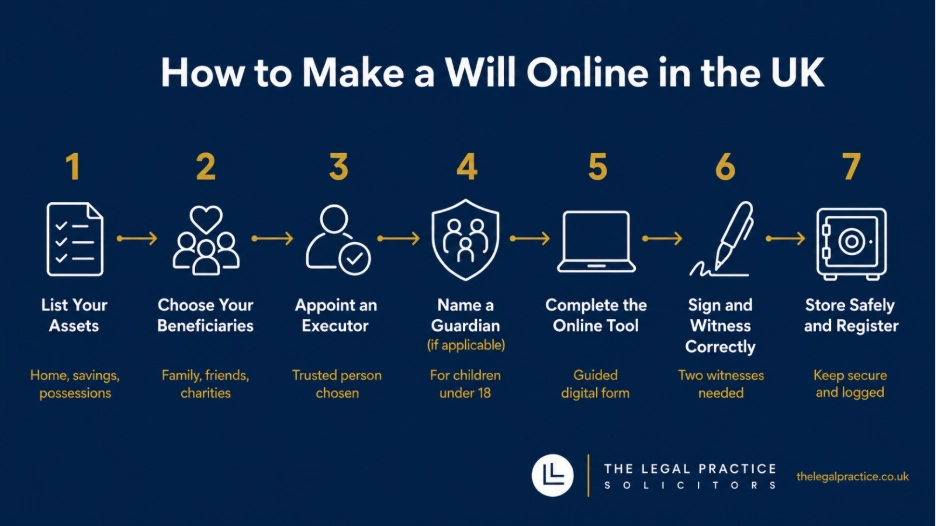
Step 1 – Take Stock of What You Own
Before opening any online tool, compile a clear picture of your estate – property, savings, investments, pensions, vehicles, valuables, digital assets, and any business interests. Note your liabilities too, such as mortgages and personal loans, because your estate settles debts before distributing anything to beneficiaries.
Step 2 – Decide Who Inherits and What
Your beneficiaries are the people or organisations you want to leave assets to. Being precise matters more than most people realise. Leaving everything to ‘my children equally’ sounds straightforward – but if a child predeceases you and you have grandchildren, vague wording creates ambiguity. Online tools prompt you for detail; use that structure carefully.
Step 3 – Appoint Your Executor
Your executor carries out the instructions in your will – applying for the Grant of Probate, paying debts, and distributing the estate. This role carries real responsibility and can take several months to complete. Choose someone you trust absolutely. Many people name a solicitor as sole executor or co-executor alongside a family member to ensure professional oversight throughout the process.
Got estate planning questions? We offer a free initial consultation.
Step 4 – Name a Guardian for Minor Children
If you have children under 18, you can and should name a guardian in your will. This is the person who would assume day-to-day care if you and any surviving co-parent were both to die. Online tools allow for this – though they cannot advise on how to structure guardianship effectively or what happens if your chosen guardian is unwilling or unable to act.
Step 5 – Use an Online Will Tool
There are several online will-writing services available in the UK. At The Legal Practice, our online will creation tool lets you work through the process at your own pace. Unlike many automated services, our solicitors are available to step in if your estate is more complex than a template can handle – so you are never left without support if questions arise.
Whichever tool you use, do not rush the beneficiary and executor sections. If any question is unclear, stop and seek advice before continuing. A small ambiguity in a will can generate a significant dispute year down the line.
Step 6 – Sign and Witness Your Will Correctly
This is the step that invalidates more online wills than any other. Once complete, you must print and sign the document in the presence of two witnesses – both must be physically present at the same moment and must watch you sign. They then each sign in your presence. The GOV.UK guidance on making a will confirms that electronic signatures are not accepted for wills in England and Wales; a temporary COVID-era exception ended in January 2022.
Neither witness should be a beneficiary, or the spouse or civil partner of a beneficiary. If you are unsure who qualifies, check with a solicitor before proceeding – it is a far smaller conversation than correcting an invalidated will later.
Not sure if an online will suits your situation? Our Wills & Probate team can advise.
Step 7 – Store Your Will Safely
A will that cannot be found when needed causes the same disruption as having none. Keep the original in a secure, dry location – not in a bank safety deposit box, which can be difficult to access after death. Tell your executor precisely where it is. You can also register it with Certainty, the National Will Register, or ask a solicitor to hold it on your behalf.
Online Will Tool vs Solicitor-Led Will Service
| Feature | Online Will Tool | Solicitor-Led Will Service |
| Cost | Often free to £100+ | From £300 + VAT (simple will) |
| Time to complete | Under 1 hour | 1-3 appointments |
| Legal validity | Valid if correctly executed | Valid and professionally reviewed |
| Complex estates | Limited | Fully suited |
| Inheritance tax advice | Not included | Can be incorporated |
| Executor guidance | Basic prompts only | Full professional advice |
| Risk of error | Higher without review | Reduced with solicitor oversight |
| Witnessing guidance | User manages independently | Solicitor advises on execution |
Source: Pricing based on Individual circumstances will affect suitability and cost.
Bottom Line: An online will work well for clear, uncomplicated estates. For anything more complex, professional advice is modest in cost compared to the risk of getting it wrong.
When an Online Will May Not Be Enough
Online tools are built for the common case. They cannot anticipate the edges of your individual circumstances – and if your situation falls outside those edges, a template carries real risk.
If you own a business, hold property abroad, are going through a separation, have children from a previous relationship, or want to reduce the inheritance tax your estate may face, our solicitor-led will service is the more appropriate route. The same applies wherever there is any realistic prospect of the will being contested after your death.
Under the Inheritance (Provision for Family and Dependants) Act 1975, certain individuals – including cohabiting partners, adult children, and financial dependants – can make a claim against your estate even if you have excluded them. A solicitor can help you structure your will to reduce, though not eliminate, that risk.
You can also find detailed guidance on what happens when someone dies without a valid will on the GOV.UK intestacy rules page – the outcome often surprises families who assumed common law or long-term relationships carried automatic rights. They do not.
Complex estate or joint family? Let our solicitors get it right from the start.
Keeping Estate Planning Within Reach
One of the most common reasons people put off writing a will is the assumption that it is expensive or time-consuming. At The Legal Practice, our Wills & Probate service is built around making that easier. A simple will starts from £300 + VAT. Mirror wills for couples are available from £500 + VAT. There are no hidden costs, and new clients receive a free initial consultation.
We are authorised and regulated by the Solicitors Regulation Authority, with professional indemnity insurance maintained in line with SRA requirements. Our wills and probate team brings decades of combined experience across straightforward estate planning and complex, high-value estates alike.
For clients outside London, video appointments are available nationwide – so you do not need to visit our Wembley Park office for professional guidance to be within reach. We also maintain meeting rooms across Hertfordshire and Buckinghamshire, in Rickmansworth, St Albans, Beaconsfield, and Berkhamsted, for clients who prefer to meet in person closer to home.
When to Review or Update Your Will
A will is not a one-time task. Major life events should prompt a review – marriage, divorce, the birth of children or grandchildren, a significant change in assets, or the death of a named executor or beneficiary.
Importantly, marriage automatically revokes a previously made will in England and Wales under the Wills Act 1837, unless the will was made expressly in contemplation of that marriage. This catches many people off guard. The Law Society recommends reviewing your will every three to five years even if no specific event has occurred.
Conclusion
Making a will online is a genuinely practical option – and for a clear, uncomplicated estate, it can produce a legally valid document that protects your wishes. The process is accessible, the tools are well-structured, and the cost is low compared to the alternative of leaving nothing in place at all.
Where people run into trouble is rarely in getting started – it is in the details. A beneficiary who also witnesses the will. Vague wording about grandchildren. A document stored somewhere no one can find it when it matters. These are not rare edge cases; they are common mistakes that a brief professional review could prevent entirely.
At The Legal Practice, our Wills & Probate team has supported families across London and nationwide for decades. Whether you prefer to use our online will tool for a straightforward will or book a solicitor-led appointment for more detailed advice, our team is here to help you choose the right route. You can reach us on 020 8903 7017, on WhatsApp at 07880927149, or through our website – because the best will is one that works when your family needs it most.
Frequently Asked Questions
1. Can I make my own will without using a solicitor in the UK?
Yes – there is no legal requirement for a solicitor to be involved in writing your will in England and Wales. You can write a will yourself or use an online tool, provided the document meets the requirements of the Wills Act 1837. However, professional involvement significantly reduces the risk of errors that could invalidate the will or lead to disputes.
2. Does an online will need to be witnessed to be valid?
Yes. Under the Wills Act 1837, your will must be signed by you in the presence of two independent adult witnesses, both present at the same time, who must also sign in your presence. A will that is not correctly witnessed is not legally valid in England and Wales, regardless of how it was created or which tool was used.
3. How long does it take to make a will online?
Most online will tools can be completed in 30 minutes to 1 hour for a straightforward estate. This does not include the time needed to prepare your asset list, choose your executors and beneficiaries, or arrange the witnessing – which must be done in person. The decisions a will captures deserve careful thought regardless of how quickly the online form can be completed.
4. Can I update my will once I have made it?
Yes – you can update your will at any time while you have testamentary capacity. Minor changes can be made through a codicil, which must be signed and witnessed in the same way as the original will. For significant changes, making an entirely new will that revokes the previous one is usually the cleaner approach.
5. What happens to my will if I get married after making it?
Under the Wills Act 1837, marriage automatically revokes a previously made will in England and Wales, unless the will was made in express contemplation of that marriage. If you made a will before your wedding and did not update it, it may no longer be valid. Reviewing your will after getting married is essential.
6. Can an online will cover digital assets such as cryptocurrency?
You can reference digital assets in any will, including one made online. However, practical matters – such as how your executor will access wallets, accounts, or private keys – are rarely addressed by template tools. If you hold significant digital assets, solicitor advice on documenting access securely alongside your will is strongly advisable.
7. How do I make sure my will is stored safely after making it?
Keep the original in a secure, accessible location such as a home safe or fireproof cabinet. Avoid placing it in a bank safety deposit box, which can be difficult to access after death. Tell your executor where it is kept. You can also register it with the National Will Register or ask a solicitor to hold it on your behalf as part of their client services.
This article is for general information only and does not constitute legal advice. For advice specific to your situation, please contact our solicitors.